The Best Hand Care Routine for People Who Wash Their Hands Constantly
Area
Daily UseKey Takeaways:
- Who’s most at risk: Anyone doing repeated wash-dry-sanitise cycles for work, especially healthcare, cleaning, hospitality and childcare
- The real cause: Frequent washing and detergent exposure, not just cold weather
- Cream or ointment beats lotion: Thicker formulas hold moisture in for longer
- One product, applied properly, every time: Consistency does more than switching between several
Nurses, cleaners, tradies and parents share the same problem: skin that never gets a break between washes. Standard hand care advice rarely accounts for that kind of repetition, which is why the usual fixes stop working after a few hours. Here’s a routine that holds up through an entire shift.
Why does constant hand washing damage your skin?
Soap and water are designed to strip away oils, dirt and bacteria. That’s exactly what makes them so hard on your hands when you’re doing it dozens of times a day.
Every wash removes a layer of your skin’s natural oils along with whatever it was meant to clean off. Add hand sanitiser and gloves into the mix, and your skin barrier never gets a real chance to recover between washes.
Over time, this repeated stripping can lead to dryness, cracking, redness and irritation. In healthcare and other frequent-wash occupations, this pattern is well recognised as an occupational skin concern, not just “very dry skin” from weather or age.
Who needs to take extra care of their hands?
Some jobs put hands through far more wear than others. If you’re in any of these roles, your skin is working harder than most:
- Healthcare workers, nurses and doctors: Hourly washing and sanitising between patients
- Aged care and support workers: Constant hygiene routines throughout every shift
- Cleaners: Repeated exposure to water, detergents and chemicals
- Hospitality and food handling staff: Frequent washing between tasks under hygiene rules
- Childcare workers: Nappy changes, mealtimes and constant hygiene demands
- Lab and wet-work staff: Gloves and washing as a standard part of the job
If this sounds like your day, the good news is there’s a routine built specifically for it.
The 7-step science-backed hand care routine
This is the part that actually matters. Seven steps, done consistently, every single wash.
Step One: Use warm water, not hot
- Hot water strips natural oils faster and dries skin out more
- Warm or cool water cleans just as well without the extra damage
- A mild, fragrance-free cleanser is gentler than a heavily scented one
Step Two: Pat dry, don’t rub
- Rubbing creates friction on already-vulnerable skin
- Patting dry with a clean towel is enough
- Leave hands slightly damp before the next step
Step Three: Moisturise immediately after every wash
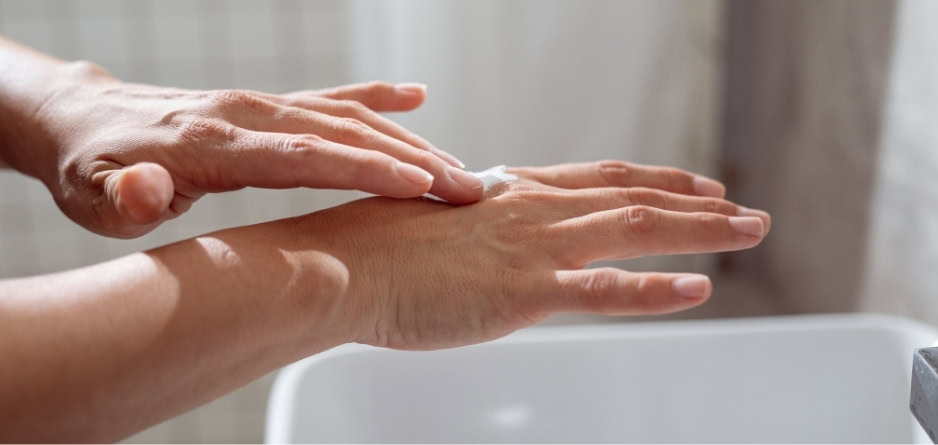
- Apply cream as soon as hands are dry, while skin is still soft from washing
- This holds moisture in rather than trying to add it back hours later
- Applying straight after every wash is what gets the most out of your hand cream
Step Four: Choose cream or ointment over thin lotion
- Thin lotions absorb fast but don’t hold moisture in for long
- Creams and ointments form a stronger barrier against water loss
- For very dry or cracked hands, richer always beats lighter
Step Five: Go heavier overnight
- Apply a thicker layer before bed, when your hands aren’t about to be washed again
- Cotton gloves overnight can help lock the product in
- This is your best chance to repair damage from the day
Step Six: Protect your hands before wet work
- Dry hands fully before gloving up for cleaning or chemical tasks
- Wet skin under gloves for extended periods can make irritation worse
- Reapply cream as soon as gloves come off
Step Seven: Start the routine before hands crack, not after
- Prevention is far easier than repair
- If skin does crack, drop harsh products and stick to cream or ointment only until it heals
- Consistency matters more than any single application
What does this look like across a real shift?
Hand Balm is made for use morning, through the day and at night, so the routine is the same product at three different points.
- Morning: Wash, pat dry, then apply before you start your shift.
- Through the day: A small amount after every wash, no exceptions.
- Night: A thicker layer before bed, when hands aren’t about to be washed again.
For a full walkthrough, see our guide on how to use Hand Balm.
Why Dermal Therapy Hand Balm fits this routine
You don’t need five different hand care products to follow this routine properly. You need one that works, used consistently, after every wash.
Here’s why Australian workers choose Dermal Therapy Hand Balm:
- 10% Urea and 2% Dimethicone: targets very dry, damaged skin directly, not just surface dryness
- Visible results in 1 day: built for people who can’t wait weeks for change
- Clinically tested on nurses: proven in exactly the conditions this routine is written for
- Non-greasy formula: back into gloves or straight back to work without residue
- Australian made diabetes friendly
As one of our valued customers put it:
“My favourite Dermal Therapy product is definitely the hand balm. Especially when working in the healthcare field. Always washing your hands l, hand sanitising with the alcohol based rub, it really dries out the skin. So being able to use this one after every shift has really helped. ”
Here’s the bottom line
Skin that washes twenty times a shift needs a hand care routine built for that reality, not a cream applied at random when hands start to crack. Follow the seven steps consistently and the barrier gets a real chance to recover between washes, even on a full shift. Dermal Therapy Hand Balm is made for exactly that gap, fast-absorbing and non-greasy enough to reapply between patients, tasks or nappy changes without missing a beat.
Hand Care Routine FAQs